
A roof in Clark County has one job for most of the year: keep out rain that falls for days at a time and, on the east side of the county, rain the Gorge wind drives sideways. Shingles rarely fail first. What lets water in is usually the edges and the joints: flashing where a roof meets a wall, a chimney or a skylight, a valley that has worn through, or a vent boot that has cracked in the sun. Those joints are the same kind of work IE Pro Exteriors does every week around windows and siding, which is why roofing sits alongside them.
Every roof job starts with Eric or Izak on the roof and in the attic. We look at the shingles, the flashing, the decking where we can see it, and the ventilation, and then tell you whether you are looking at a repair or a replacement. If a repair will honestly buy you years, that is what we quote.
Repair or Replace?
When a repair is the right call
A leak at one penetration, a few shingles lost in a windstorm, a cracked pipe boot or a failed step flashing at a sidewall can all be fixed without a new roof, as long as the rest of the shingles still have life in them. Granules still on the surface, shingles that lie flat, and decking that is firm underfoot are good signs.
When it is time for a new roof
Curling or cracked shingles across a whole slope, bare spots where the granules have washed into the gutters, moss that has lifted the shingle edges, soft decking, or leaks in more than one place usually mean the roof has reached the end of its life. Patching one leak on a roof like that just moves the next leak somewhere else.
How a Replacement Goes
Tear-off and decking
The old roofing comes off down to the decking so we can see what is under it. Soft or rotten sheathing is replaced before anything new goes on, and we tell you what we found before we close it up.
Underlayment, edges and valleys
Underlayment goes down over the whole deck, with leak barrier at the eaves and in the valleys where water concentrates, and new drip edge along the eaves and rakes.
Flashing
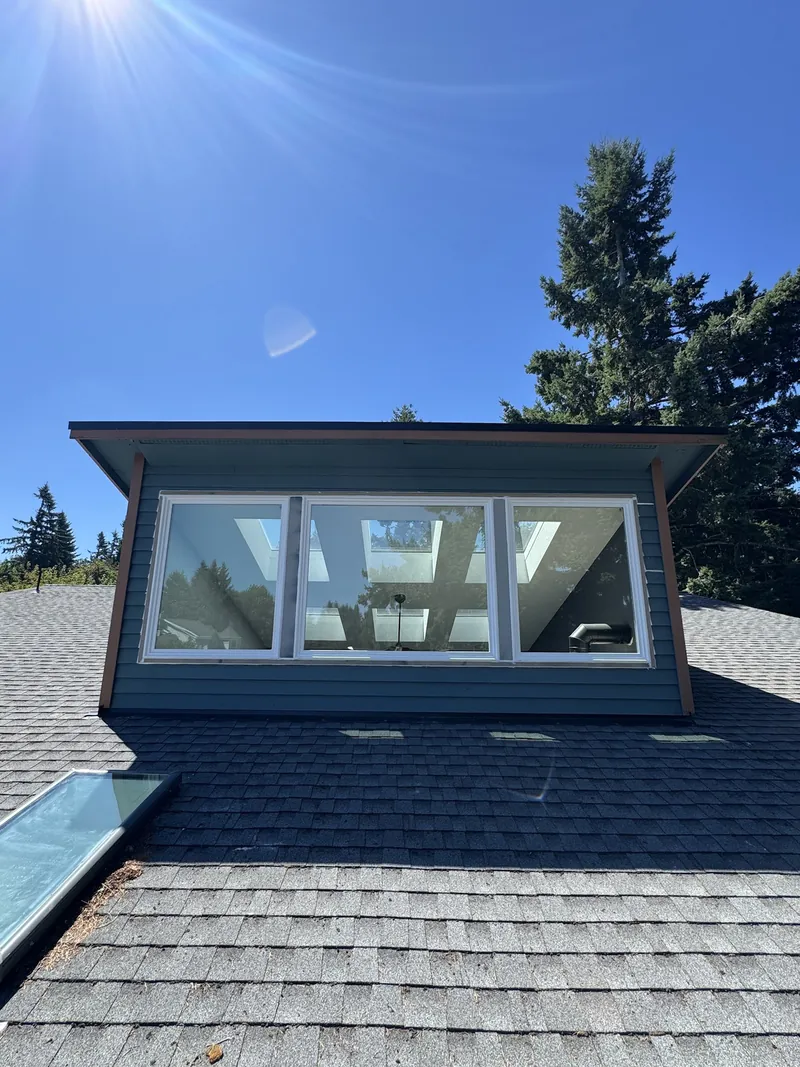
Step flashing where the roof meets a wall, counter-flashing at chimneys, and flashing kits at skylights and dormers. This is the part of a roof that leaks most, and the part where having the same crew handle the siding and windows above it matters: the flashing laps under the siding and the weather barrier, not over them.
Shingles, vents and cleanup
New composition shingles, new pipe boots and roof vents, and ridge caps. Nails and debris are picked up from the yard and driveway with a magnet before we leave.
Permits
Whether a reroof needs a permit depends on the building department for your address and on whether the decking or structure changes. Inside a city that is the city: Vancouver, Camas, Washougal, Battle Ground, Ridgefield, La Center and Woodland each have their own. Outside one, including Hazel Dell, it is Clark County Community Development. We check for your address and pull the permit where one is required.
Why Homeowners Choose IE Pro for Roofing
- The owners inspect it. Eric or Izak walks the roof and looks in the attic before anyone quotes a number.
- Repair when a repair will do. If the roof has years left, we quote the fix, not a new roof.
- Flashing done with the walls in mind. Roof-to-wall joints are flashed under the siding by the crew that does the siding.
- A written, itemized quote. Nothing to sign on the day of the visit.
- Registered, bonded and insured. WA L&I general contractor registration IEPROE*797LN, active since June 2021.