
Windows and doors are the job IE Pro Exteriors does most, and the one every review on the company’s Google listing mentions. Eric and Izak Garrison measure the openings, order the units to size, set and flash them, and cut in whatever trim and siding the job needs, all with the same crew. The photo above is a triple picture window they installed into dark lap siding; the trim was still raw when the photo was taken because painting it is the last step, and it is theirs too.
There are two ways to replace a window, and choosing the wrong one is how homeowners end up paying twice. A glass insert replaces the sealed double-pane unit inside your existing frame and leaves the frame, trim and siding alone. A full-frame replacement takes the whole window out to the rough opening and installs a new unit with new flashing. Inserts cost less and suit a sound frame. Full-frame is the answer when the frame is rotten, corroded, out of square, or when you want a different size or style. We look at the frame before we quote, and when it is close we price both.
Doors follow the same logic. A sliding patio door with a fogged panel and a good frame can take a new glass panel; a slider whose track has worn through or whose frame has sagged gets replaced. A slider can be swapped for French doors, and a fixed window can be reframed into a door, though that second job is a permit and a header, not a swap.
What Goes Wrong With Windows in Clark County
Most of the housing in Vancouver and the county went up in three waves, and each wave fails in its own way.
1960s and 1970s: original aluminum sliders
The ranches and split-levels in Vancouver, Hazel Dell and older Battle Ground came with single-pane aluminum sliding windows. Aluminum conducts heat straight through, so the frames sweat all winter, and forty or fifty years of condensation has usually corroded the sill track and rotted the wood behind it. There is no insert solution for these: the frame is the problem. They are replaced full-frame with a double-pane unit, new flashing and, where the sill has rotted, new framing behind it.
1980s and 1990s: early vinyl and wood
Wood windows from this period can be in fine shape or can be rotten at the bottom rail depending on how they were painted and which way they face. Early vinyl windows have frames that hold up but sealed units that have long since failed. This is the era where the insert-or-full-frame question is real, and where we spend the most time on the first visit checking each opening.
2000s onward: builder-grade vinyl
The subdivisions in Battle Ground, Ridgefield, Camas and east Vancouver from the last twenty-five years mostly came with the least expensive vinyl window the builder could buy. They are now fogging between the panes and letting air through at the sash. The frames are generally straight and dry, so a glass insert fixes the fog and a better replacement unit in the same opening fixes the drafts. Which one you want depends on how long you plan to stay.
Fogged Glass: What a Failed Seal Actually Is
A modern window is two panes of glass sealed around the edge with a spacer and a desiccant, and filled with air or argon. When the seal fails, moist air gets between the panes, the desiccant saturates, and the window fogs or shows a water line that will not wipe off from either side. The glass has not broken and the frame has not failed; the sealed unit has. If the sash and frame are sound, the fix is a new sealed unit cut to the same size and set into the existing sash. It is a fraction of the cost of a new window and it is the honest recommendation more often than not.
The trap is a failed seal in a frame that is also failing. Vinyl that has warped, wood that is soft at the corners, or a sash that no longer locks means the frame is on its way out, and a new sealed unit in it is money spent twice. We check the frame before we recommend an insert, and we say which one we are looking at.
Changing the Size or Style of an Opening
Some of the most satisfying jobs are the ones where the opening changes. A garage with a shattered full-size window that the owner wanted turned into a smaller functional slider; a living room that wanted one big picture window where three small ones had been; a wall that wanted a window where none was. That work is reframing: a new header sized for the span, new king and jack studs, new sheathing and weather barrier, the window set and flashed, and then siding cut in to meet the new trim so it reads as original to the house. It is the part of the job where having the siding and paint done by the same crew matters most, because a patch that almost matches is what everyone sees for the next twenty years.
Changing an opening needs a building permit in Washington, and the new window has to meet the state energy code for U-factor. Inside a city, the city’s building department issues it; outside, Clark County Community Development does. We handle the application and the inspection.
Patio and Entry Doors
Sliding glass doors
The most common door replacement we do. A slider is measured and ordered like a window, and it goes in on the same visit as the windows when the crew is already set up. If the frame and track are good and only the glass has fogged, a new sealed panel is the fix. If the track has worn through or the door has dropped and drags, it is replaced.
French and hinged patio doors
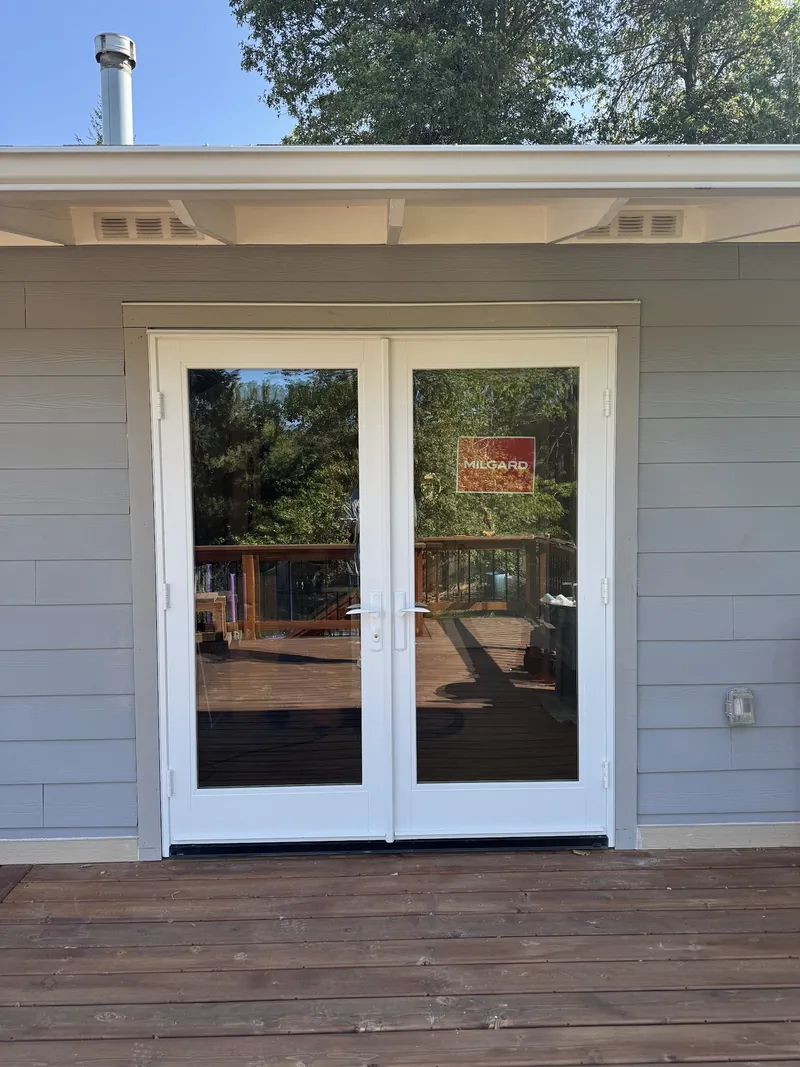
A slider opening can take French doors, and often the reason for the change is that the owner wants a door that opens fully. The rough opening is the same width; the header and sill are checked and the new unit is set and flashed. The doors in the photo above are a pair we installed off a deck.
Entry doors
Front and side entry doors, pre-hung in a new frame with new weatherstripping and a new threshold. An entry door that has been letting light through at the bottom corner for years is usually a threshold and sweep problem that a new pre-hung unit solves in an afternoon.
How a Window Job Runs
The visit comes first. We measure every opening you are asking about, check the frames, and talk through insert versus full-frame on each one. You get a written, itemized quote. When you go ahead, the units are ordered to size and we give you the delivery date when we have it. Lead times vary by manufacturer and time of year.
Install day starts with the old units coming out and the openings being checked for rot and flashing problems that were hidden behind the trim. New units are set level, plumb and square, shimmed, fastened, flashed to the weather barrier and sealed. Trim goes on, siding is cut in where the opening changed, and the trim is primed and painted to match. Most whole-house replacements take one to three days depending on the count and whether any openings are being reframed. The site is cleaned before we leave, and the old windows go with us.
Why Homeowners Choose IE Pro for Windows
- Insert or full-frame, decided honestly. A fogged window with a sound frame gets a glass insert. We price both when it is close, and we say which one we would do on our own house.
- The owners measure and install. The person who measured your openings is the person who sets the windows. There is no sales rep and no crew you have not met.
- Siding and trim are part of the job. When an opening changes, the siding around it is patched and matched by the same crew, then painted. No second trade and no seam that reads as a patch.
- Registered, bonded and insured. WA L&I general contractor registration IEPROE*797LN, active since June 2021, with the bond and liability insurance the state requires on file.
- Permits handled where they apply. Same-size replacement generally needs none; a changed opening does, and we file it with the city or county for your address.