
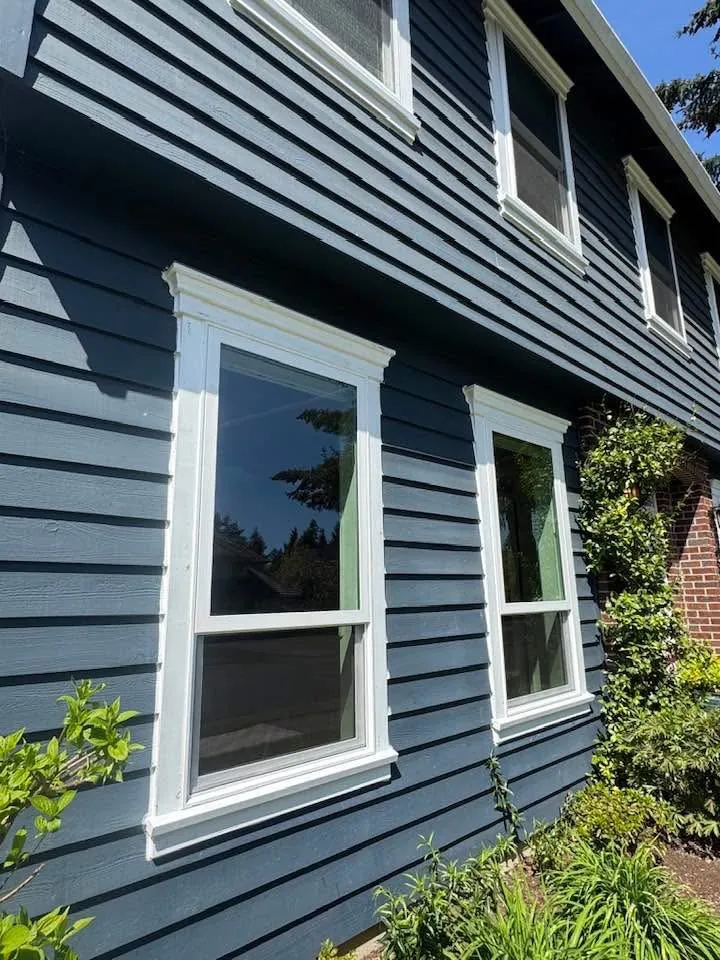
Siding is what keeps water out of the wall, and it is also the first thing anyone sees. IE Pro Exteriors installs new lap siding on whole walls and whole houses, and does a great deal of patch-and-match work: cutting new siding in around a window that was made smaller or larger, replacing the soft boards below a window where the flashing failed, and blending the patch so it disappears. The photo above is a covered patio mid-project, with new blue lap siding and new windows going in together.
Most of the siding work we do starts with a window. When an opening changes size the wall around it has to be closed with new sheathing, new weather barrier, new flashing and new siding cut to meet the new trim. Done by a second contractor after the window crew has left, it reads as a patch for the life of the house. Done by the same crew that set the window, with the profile matched and the paint blended, it reads as original. One of our customers on Google put it this way: they matched the exterior siding so seamlessly that it is hard to tell it is not original to the house. That is the standard.
The rest of the siding work is failed material. Hardboard siding from the 1970s and 1980s swells at the bottom edge and at every nail hole once the paint stops keeping water out. Cedar that was never back-primed cups and splits. Vinyl cracks in the cold and warps in the sun on a south wall. When it is one wall, we replace the wall. When it is the house, we say so.
Siding Materials We Install
Fiber cement lap siding
Cement, sand and cellulose fiber pressed into boards that do not rot, do not burn and do not interest insects. It is what most Clark County re-siding jobs use today, and it holds up to the wind-driven rain off the Gorge better than anything else at its price. It comes primed and needs a finish coat, and it has to be cut with the right blade and dust control, flashed at every joint, and fastened to the manufacturer’s schedule. Done right it is a thirty-year wall.
Engineered wood lap siding
Wood strands bonded with resin and wax, treated against rot and termites, and pressed with a wood grain. It is lighter and easier to cut than fiber cement, takes paint well, and is the choice when the budget or the look points that way. Like fiber cement it comes primed and gets painted on the wall.
Vinyl siding
The least expensive option and the only one that never needs paint. Vinyl moves with temperature, so it has to be hung loose on its nails with room to expand or it buckles in July. It suits a rental or a house where the budget decides, and it can be a good answer for a garage or shop.
Patch and match on existing siding
Cedar lap, T1-11, hardboard, early fiber cement and vinyl all have profiles that can still be matched or closely replicated. For a patch, the new boards are cut to the same exposure, the joints are staggered away from the old ones, the flashing is replaced, and the patch is primed and painted to blend. Where the paint on the rest of the wall has faded, we feather the new paint out to a corner or a trim line so there is no hard edge.
How to Tell Your Siding Has a Problem
Soft spots when you press on it, especially below windows and at the bottom course. Paint that keeps peeling in the same place no matter how often it is redone, which means water is coming from behind. Boards that have swollen at the bottom edge or cupped away from the wall. Staining on the siding below a window corner. Daylight or a draft at the inside corner of a window frame. Any of those is worth a visit, and the visit is free.
On the east side of the county the east wind out of the Columbia Gorge drives rain sideways into east- and south-facing walls all winter, and any gap in window flashing or a siding joint on those elevations takes water. Washougal and Camas houses fail on the east wall first, and that is the wall we look at first.
Flashing Is the Job
Siding sheds water; flashing keeps it out. Every window and door gets a sill pan, side flashing lapped over it, and head flashing lapped over the sides, all tied into the weather barrier so water that gets behind the siding runs down and out rather than into the framing. Every horizontal joint in lap siding is lapped so water runs over it. Every butt joint gets a flashing strip behind it. Kick-out flashing at the bottom of a roof-to-wall joint keeps a whole wall from rotting. None of it shows when the job is done, and all of it is what decides whether the wall is dry in ten years. It is the part of the work we will not hand to a second trade.
Siding and Windows Together
If the windows are due, doing them with the siding is the cleanest way to get the flashing right, because the wall is open. The old siding comes off, the old windows come out, the sheathing is checked and any rot is cut out and replaced, new weather barrier goes on, the new windows are set and flashed, and the new siding goes up over it all. The alternative, siding first and windows later, means cutting the new siding back around every opening to flash the new windows, and it never looks as good. We quote both together so you can see the difference.
Permits and Reviews
Re-siding a house in the same material generally does not require a building permit in Washington. Changing the size of an opening at the same time does. Some cities and many HOAs in Camas and Ridgefield review exterior changes, especially a new profile or a new color, and we can supply the product details a review board asks for. We check for your address before starting.
Why Homeowners Choose IE Pro for Siding
- The patch reads as original. Profile matched, joints staggered, paint blended. A customer on Google says it is hard to tell the patched siding is not original to the house.
- Windows, siding and paint from one crew. The seams between three trades are where water gets in. Here there is one trade.
- An honest scope. One soft wall gets one wall. A house of failed hardboard gets told it is a house, with the price to match, before anything is ordered.
- Registered, bonded and insured. WA L&I general contractor registration IEPROE*797LN, active since June 2021.
- Painted as part of the job. Fiber cement and engineered wood go up primed and get their finish coat from us, so one crew is responsible for the whole wall.