
Window installation in Vancouver, WA is a different job from one street to the next, because the city was built over seventy years with three very different kinds of window. IE Pro Exteriors handles window replacement across the city from its office on Kansas Street, and the two owners order and install every unit they measure. Below is how that work changes by neighborhood, which office reviews a permit, and how to tell what your own windows need.
The rule of thumb is simple: the older the house, the more of the window comes out. A wood sash from 1948 usually leaves with its frame.
An aluminum slider from 1972 leaves down to the studs. A vinyl unit from 1994 may only need new glass. Each opening gets looked at before a price is written, so the quote describes the windows you have rather than an average house.
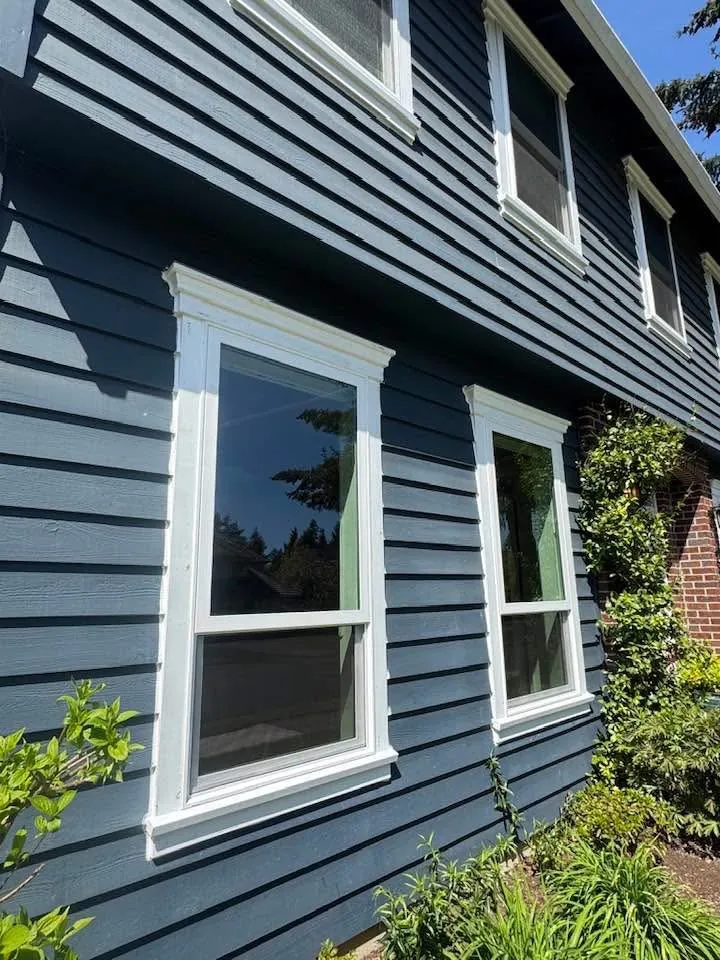
Window Replacement in Vancouver, Neighborhood by Neighborhood
Fruit Valley and Hough: wood windows from the 1940s and 1950s
Many of these houses still have their first wood double-hung sashes, often with the sash cords cut and the counterweights loose inside the wall. When we replace them, the empty weight pockets beside each window are insulated before the new frame goes in, since an open cavity there is a steady source of cold air. The wide, flat casings on houses of this age are often worth keeping, so we pull them carefully and reset them around the new unit where the wood is sound.
Sills on these windows take the most weather and are usually the first part to go soft. A rotten sill is rebuilt in new lumber before the window is set, because a new unit resting on decayed wood will be out of level within a few winters.
Bagley Downs and Ellsworth: aluminum sliders from the 1960s and 1970s
The original aluminum windows in these ranches and split-levels were nailed through a flange that sits behind the siding. Getting that flange out cleanly means opening a narrow strip of siding around each window, so a full-frame job on one of these houses is partly a siding job. We cut back only as far as the new flashing needs, then close the wall with matching boards and paint them.
Bedroom windows in these houses tend to be small and set high on the wall. If you want a bedroom window big enough to climb out of, the opening has to grow, and that turns a swap into a permitted job with a new header.
Cascade Park: vinyl from the 1980s and 1990s
Much of Cascade Park was built with vinyl windows from the start. Thirty-odd years on, the frames are usually still square, but many sealed units have fogged and the sash locks have worn. On these houses we often split the work: glass inserts where the frame is sound, and new units where the vinyl has cracked at a welded corner or the sash no longer closes tight. A south or west wall usually wears out before the north side, so the answer can change from one room to the next.
City of Vancouver or Clark County: Who Reviews the Permit
Which office handles your window replacement depends on where the lot sits, not on the city printed in your mailing address. City limits and ZIP codes do not line up, and plenty of homes with a Vancouver address are in unincorporated Clark County. For a lot inside the limits, the City of Vancouver issues building permits; for one outside them, in places such as Felida, Salmon Creek and Orchards, Clark County Community Development does.
For a same-size swap the difference rarely matters, since putting a new window into its existing opening generally needs no permit from either office. It matters once the opening changes: a wider picture window, a new window in a blank wall, or a window turned into a door. Each of those needs a permit and an inspection, and the new unit has to meet the Washington State Energy Code. We look up the parcel before ordering so the application goes to the right counter the first time.
Insert, Full-Frame or a New Opening?
Three questions settle it. First, is the frame sound? Press a screwdriver into the bottom corners of a wood frame, or look for hairline cracks at the corners of a vinyl one; soft wood or a split corner means the frame has to go.
Second, is the trouble the glass or the air? Fog you cannot wipe away is a glass problem.
A draft you can feel at the edge of the sash points to the frame or the weatherstripping. Third, do you want the opening to stay as it is? If you want more light, a different style or a door, the frame comes out no matter what shape it is in.
For most Vancouver houses built before 1980 the answer is full-frame. For newer houses it pays to check each window on its own, and when a house has some of both, the inserts and the new units are priced line by line on one quote.
Before the Measuring Visit
The year your house was built tells us more than any other single fact, and Clark County’s property records list it for every parcel. Beyond that, a rough count of the windows you are thinking about, a note of which ones fog, stick or rattle, and whether any rooms run cold in January is plenty. We take every measurement ourselves, so there is no need to measure anything before we arrive.
For the details of glass inserts, full-frame units and patio doors, see our windows and doors page. The window installation page covers how a new unit is set and flashed anywhere in the county, and the Vancouver service area page covers siding, painting and everything else we do in the city.
Why Vancouver Homeowners Hire IE Pro for Windows
- Matched to the age of the house. A 1948 sash, a 1972 slider and a 1994 vinyl unit each get a different job, and the quote says which one each opening is getting.
- Two owners, start to finish. Eric and Izak Garrison take the measurements, place the order and set the windows on install day.
- The wall around the window is ours too. Siding opened to pull an old flange is closed with matching boards and painted by the same crew.
- The right permit office. We check whether your parcel is in the city or the county before anything is ordered.
- A Washington registered contractor. WA L&I registration IEPROE*797LN, active since June 2021, with a free written quote for every visit.